
Seeing Enhancement#
STRATA, the planned adaptive-optics system using Keck I’s adaptive secondary, will concentrate light for ZShooter spectroscopy and imaging. ZShooter will also operate in natural seeing.
Performance overview#
Science path |
Image-quality estimate |
Field used in the AO model |
|---|---|---|
ZSpec |
Approximately 0.15″ FWHM in R–K, before deliberate defocus to match spectrograph sampling |
On-axis correction |
ZImager |
Field-averaged FWHM of approximately 0.35–0.4″ at 0.31 µm, improving to approximately 0.2″ at 1 µm |
A 3′-diameter circular correction field |
The ZImager values are approximate readings of the September simulation curves below. The correction field differs from the camera’s detector footprint.
The baseline uses four laser guide stars in a square asterism: 15.2″ in diameter for ZSpec and 50″ for ZImager. It includes facility guiding without requiring a bright star for fast, on-axis tip/tilt sensing. Six lasers give little improvement in these cases. Fast tip/tilt correction gives its largest gain with an on-axis star in the narrow ZSpec field.
Matching the PSF to the spectrograph#
Set the NIR reference with telescope focus. Defocus the telescope so the PSF’s EE80 matches the NIR Nyquist slit width.
Tighten the VIS image with relative focus. Adjust the VIS/NIR relative-focus mechanism for the VIS slit, balancing U-band losses against R-band gains.
Calibrate focus and slit coupling. Measure focus curves and wavelength-dependent slit throughput through the telescope and relative-focus calibration.
This replaces the flat tip/tilt-error allowance used in the older SPIE simulations. The AO plots below report EE50; the focus prescription needs EE80 evaluated directly from the PSFs for the slit geometry.
Considerations for ZShooter#
Simulation scope: median turbulence, 30° zenith angle, 600 Hz sampling, and 10-second simulations averaged over four turbulence seeds. Windshake and vibration are included; instrument implementation errors are not.
Guide stars: establish brightness limits, truth-sensing needs, and sky coverage for the optional fast tip/tilt correction.
Laser/WFS: 25 W-class lasers suffice at the modeled sodium return, wavefront-sensor throughput, and read noise. More lasers or faster sampling give limited gains when residual tip/tilt dominates.
RNAS dichroic: the modeled laser pickoff avoids vignetting the science field and helps reject Rayleigh backscatter. Its transmission, chromatic effects, wavefront error, and ghosts remain inputs to the ZShooter budgets.
PSF mapping: evaluate correction across ZImager’s actual bands and rotating detector footprint, and evaluate the VIS focus trade between U-band losses and R-band gains.
Simulation results#
ZSpec#
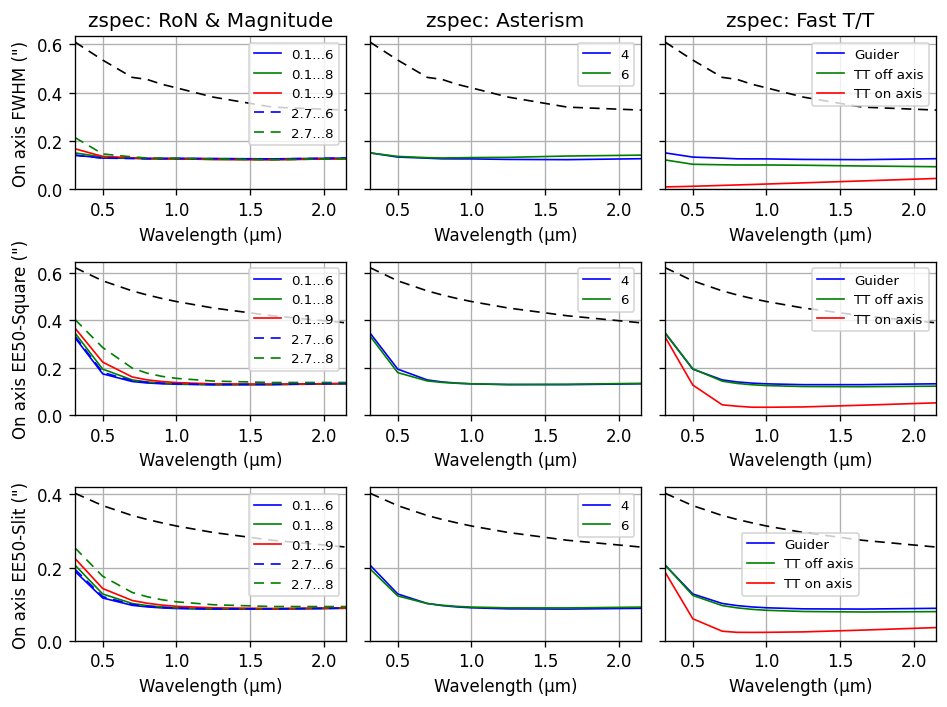
ZSpec on-axis predictions. Rows show FWHM, the square width enclosing 50% of the energy, and the slit width enclosing 50%. Columns compare laser signal/read noise, laser count, and tip/tilt configuration. Dashed black curves show the uncorrected case.
ZImager#

ZImager predictions averaged over the 3′-diameter field, with the same metrics and comparisons as ZSpec. Error bars show variation across the field.
Sources
Lianqi Wang, STRATA Simulation Configuration and Results, 26 September 2026, version 2: slides 2–3, 11–17, and 34–35. Figures reproduced from slides 11 and 15.
STRATA MAOS Simulation Baseline Configuration and Trade Studies, 27 August 2026: performance evaluation, ZSpec and ZImager configurations, conclusions, and future work.
ZShooter instrument paper, SPIE 2026, Section 7 and Table 3: the earlier seeing-enhancement and natural-guide-star comparison. See Publications.
The 0.15″ ZSpec working estimate and telescope/VIS focus strategy follow the current instrument direction. The Performance numbers still use the saved notebook’s broader effective AO PSF.