
Nebular Supernovae#
Late-time spectra measure the composition and geometry of supernova ejecta after the continuum optical depth has declined.
At these epochs, the line profiles come from the inner ejecta and can distinguish explosion models that are similar at early times. Line fluxes and asymmetries test progenitor mass, mixing, and the energy source.
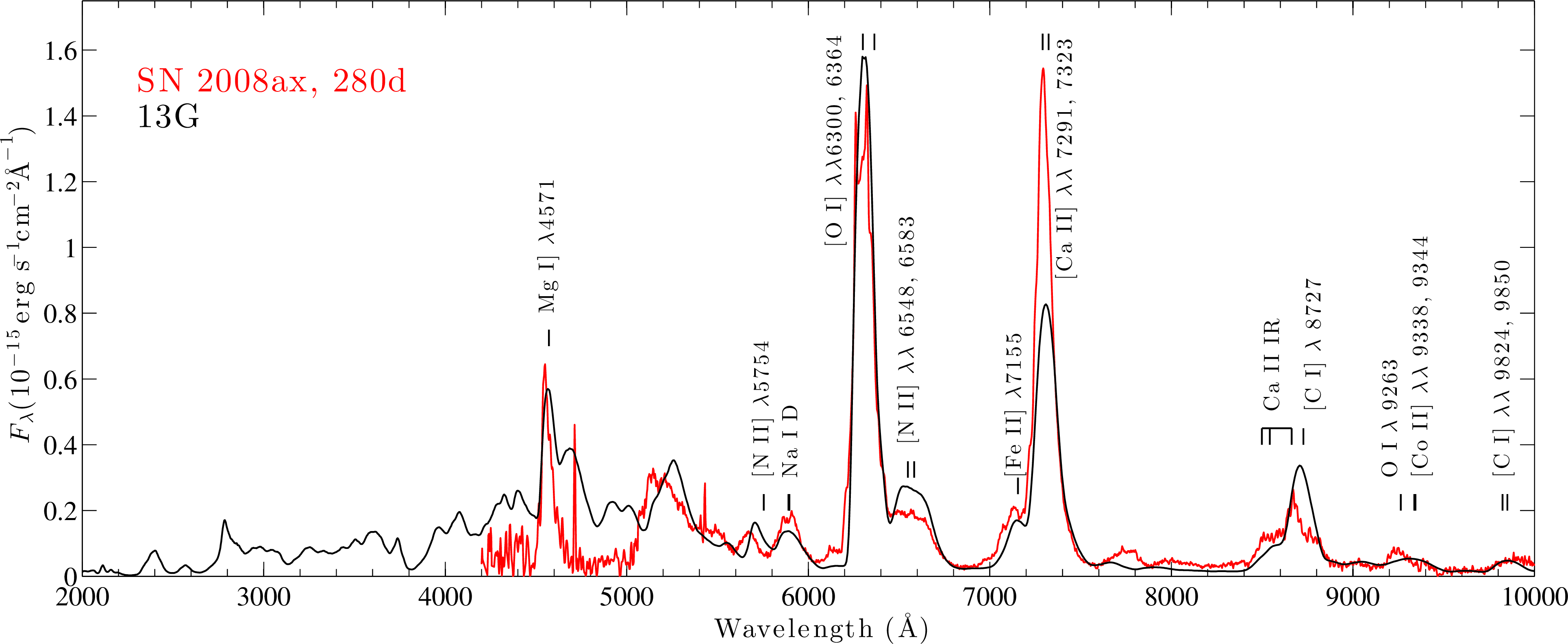
Observed optical nebular spectrum of SN 2008ax in red compared with a 13 solar-mass progenitor model
in black. The optical spectrum is at 280 days.
Source: Jerkstrand et al. 2015, A&A, 573, A12, Figure 8; ZShooter SRD Section 2.3.7.#
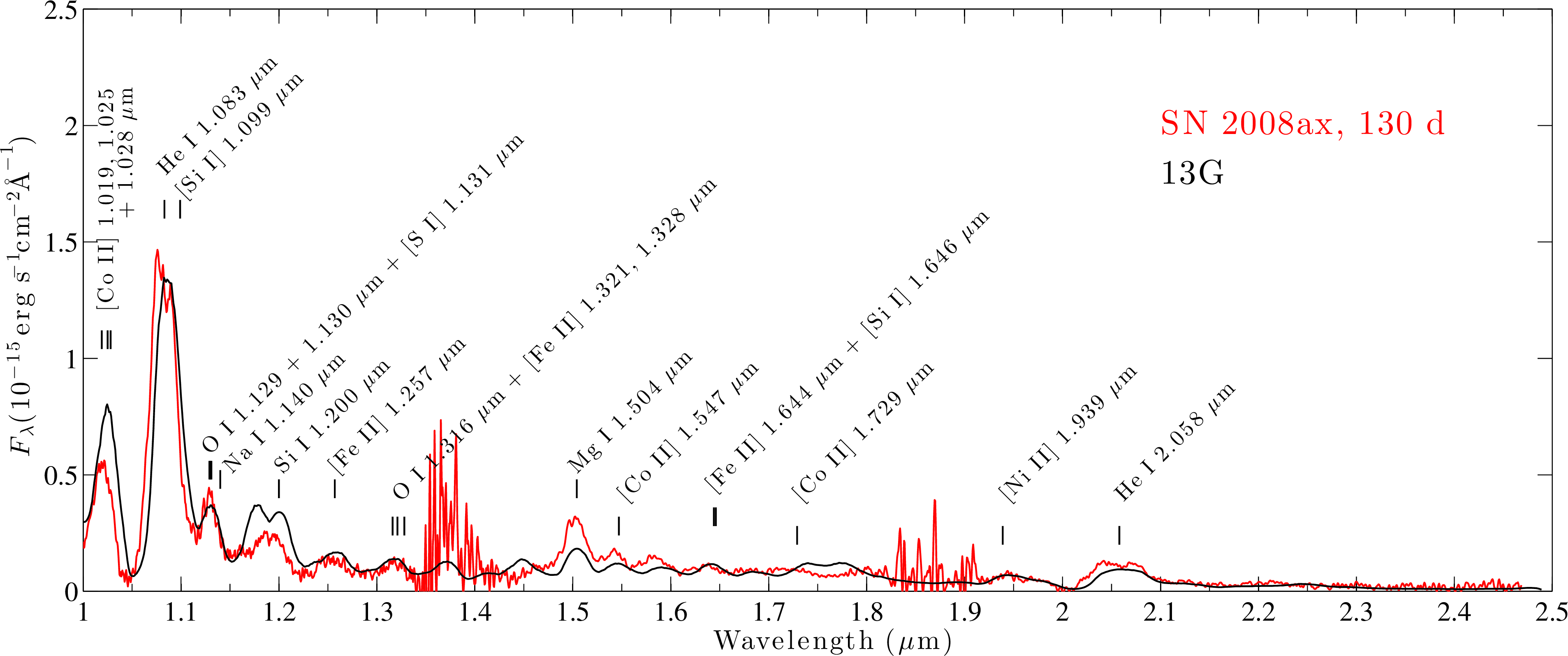
Observed NIR nebular spectrum of SN 2008ax in red compared with a 13 solar-mass progenitor model in
black. The NIR spectrum is at 130 days.
Source: Jerkstrand et al. 2015, A&A, 573, A12, Figure 6; ZShooter SRD Section 2.3.7.#
Science Drivers#
[O I] 630.0, 636.4 nm, [N II] 654.8, 658.3 nm, and other optical and NIR lines constrain progenitor mass, nucleosynthesis, and the power source.
Instrument Requirements#
R ≈ 3,000 is the primary mode. R ≈ 10,000 is used when narrow circumstellar components must be separated.
Absolute line luminosities require spectrophotometric accuracy of ≈ 10 percent.
Observing Requirements#
Reference targets are r ≈ 24 at S/N = 5.
Individual exposures of ≈ 15 minutes can be combined for faint targets while limiting cosmic-ray and background-subtraction losses.