
White Dwarf Systems#
Atmospheric pollution in white dwarfs measures the composition of accreted planetary material. Gaseous and dusty debris require additional optical and NIR diagnostics.
These abundances are one of the few direct measurements of rocky material outside the Solar System. Separating atmospheric, circumstellar, and dust emission is needed to infer the parent-body composition.
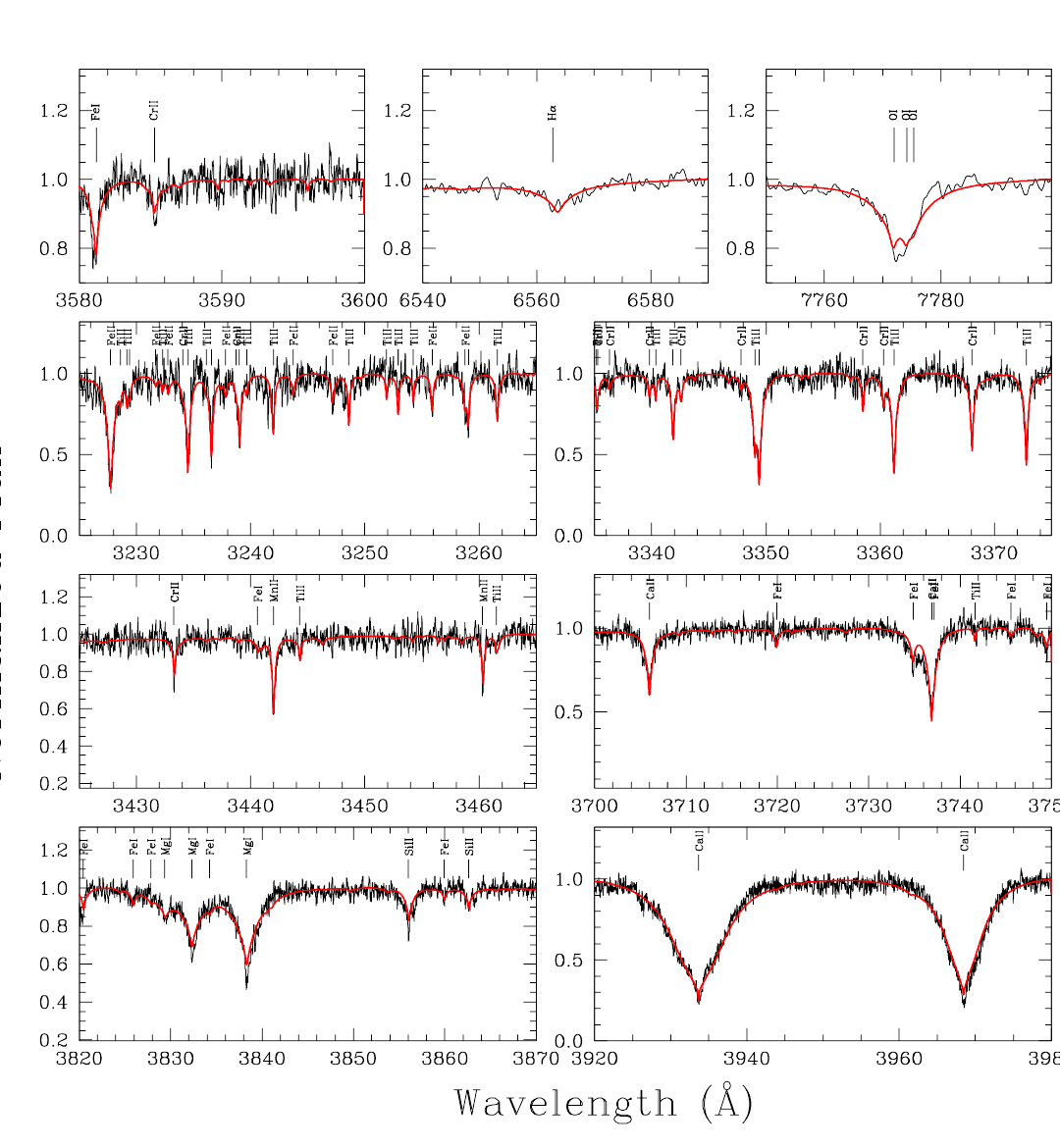
Observed spectrum of the polluted white dwarf WD 1232+563 with the best-fit atmospheric model. The
blue optical spectrum contains numerous metal lines used for abundance measurements.
Source: Xu et al. 2019, AJ, 158, 242, Figure 11; ZShooter SRD Section 2.3.9.#
Instrument Requirements#
Important abundance transitions extend from ≈ 310 to 900 nm. Simultaneous coverage avoids separate blue and red configurations.
R ≈ 40,000 is required for hot white dwarfs and for separating atmospheric from circumstellar absorption.
R ≈ 10,000 to 20,000 is sufficient for broader lines in cooler stars and many gaseous debris disks.
Low-resolution 0.6 to 2.45 um spectrophotometry measures the continuum excess from dusty debris.
Observing Requirements#
The reference requirement is g ≈ 20 at S/N at least 30, with relative spectral-shape accuracy at most 5 percent.