
High-redshift Supernovae#
High-redshift supernovae and their host galaxies require broad wavelength coverage because the principal classification and redshift features move into the NIR.
Reliable classification and host redshifts are needed for distant supernova rate and population measurements. Broad coverage reduces misclassification when only a small number of broad features are detected.
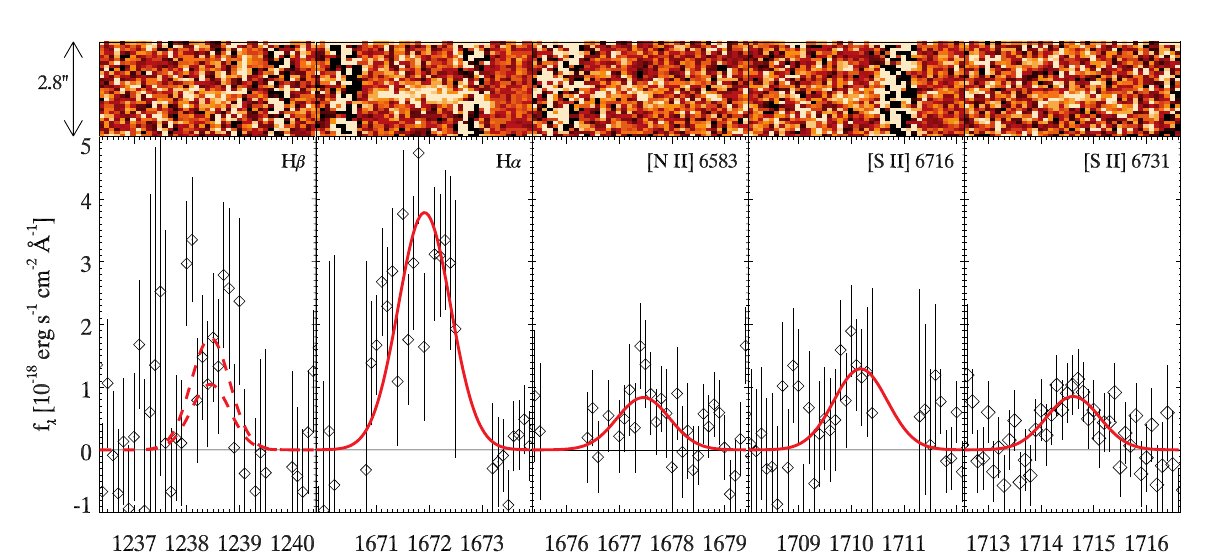
X-shooter 1D and 2D spectrum of the z = 1.55 host of a Subaru Deep Field supernova. H beta, H alpha,
[N II], and [S II] provide the spectroscopic redshift and host diagnostics.
Source: Frederiksen et al. 2014, A&A, 563, A140, Figure 2; ZShooter SRD Section 2.3.5.#
Instrument Requirements#
Simultaneous optical and NIR coverage reduces ambiguity when only a small number of emission or absorption features are detected.
Observing Requirements#
Reference targets are i ≈ 24.5 and YJ ≈ 24 at S/N = 5.
Spectra binned to R ≈ 200 to 500 provide classification, host redshifts, and broad spectral features.
The nominal response time is within one day.