
Solar-system Objects#
Comets and small bodies require broad spectral coverage for composition and high resolving power for selected gas and isotope measurements.
These observations test whether surface or coma composition differs among object classes and heliocentric distances. Isotope and band-structure measurements add information that broadband colors cannot provide.
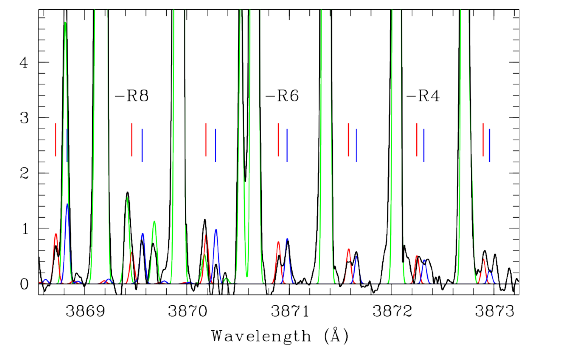
UVES spectrum at R ≈ 80,000 of the CN B-X band in comet C/2015 ER61, compared with synthetic spectra
of three carbon and nitrogen isotopologues. The weak isotope components illustrate the motivation
for the enhanced-resolution case.
Source: Yang et al. 2018, A&A, 609, L4, Figure 2; ZShooter SRD Section 2.3.12.#
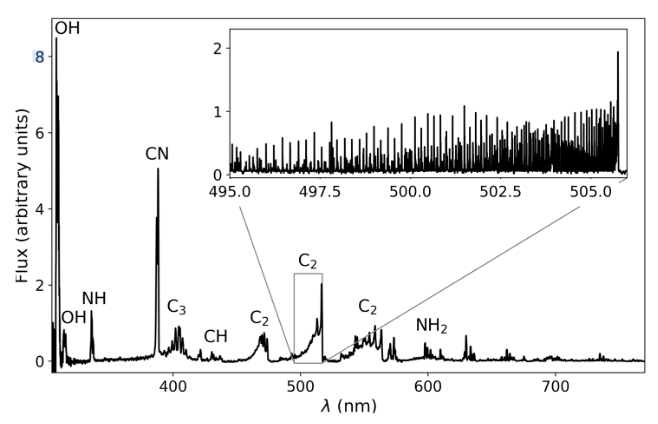
Optical spectrum of comet C/2015 ER61 showing OH, NH, CN, C3, CH, C2, and NH2 emission.
Source: Biver et al. 2022, Chemistry of Comet Atmospheres, in Comets III, Figure 4.#
Science Drivers#
Low-resolution spectra measure reflectance and molecular production rates.
Diagnostic wavelengths include OH near 308 nm, CN near 388 nm, the 0.7 um hydration band, mafic bands near 1 and 2 um, and OH combinations near 2.2 to 2.3 um.
Instrument Requirements#
R ≈ 10,000 to 40,000 is the enhanced mode for selected band structure and isotope measurements.
Observing Requirements#
The reference target is r ≈ 22 at S/N = 5, with response within one day and individual exposures no longer than ≈ 20 minutes.
Non-sidereal tracking and background subtraction are required for moving targets.