
Young Supernovae#
Spectra obtained during the first hours and days after explosion measure short-lived emission from circumstellar material and the outer ejecta.
The short-lived lines identify material lost by the progenitor shortly before explosion. This connects the early spectrum to the final years of stellar mass loss.
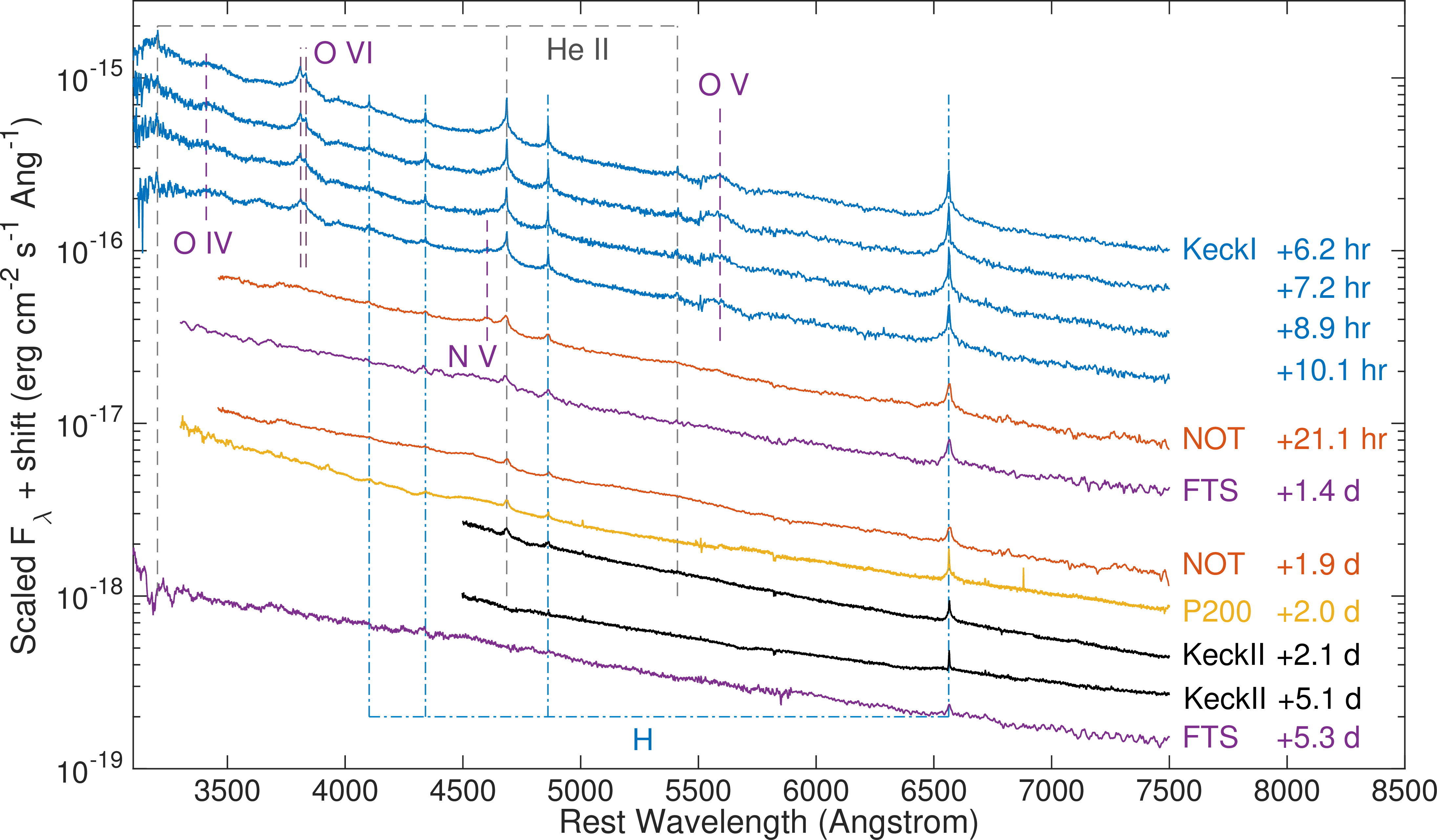
Spectral sequence of SN 2013fs beginning 6.2 hours after explosion. The high-ionization flash
features disappear within the first days.
Source: Yaron et al. 2017, Nature Physics, 13, 510, Figure 2; ZShooter SRD Section 2.3.2.#
Instrument Requirements#
The 0.31 to 2.45 um range includes blue O and He lines, optical H and He, and He I features in K band.
R > 10,000 is used to separate narrow components and constrain winds of 10 to 50 km/s for brighter targets.
Observing Requirements#
For events within ≈ 50 Mpc, the source can be fainter than 23 AB during the period when flash-ionized lines are present.
The baseline requirement is S/N = 5 at ug ≈ 23 and R ≈ 3,000 in one hour.
Observations are required within 15 minutes. Three-band imaging supports photometric calibration and continued monitoring.