
Performance#
ZSpec covers 0.31–2.45 µm at native resolving powers of approximately 18,000 with a 0.70″ slit and 38,000 with a 0.33″ slit. The dark-time model reaches 24.49 AB in VIS and 23.87 AB in YJH at R≈1,000 in one hour, increasing to 24.93 and 24.33 AB with seeing enhancement.
ZSpec conditions: airmass 1.1; natural seeing 0.65″; a flat-fν point source; S/N=5 per reported resolution element. One hour is two 1,800-second exposures; five minutes is one 300-second exposure. Times are on source; the noise budget includes an equal-duration independent sky reference.
Limiting magnitude#

One-hour limits with OH-line emission disabled, comparing the 0.70″ and 0.33″ slits in natural seeing and the 0.33″ slit with AO. The table below includes OH emission with a S/N-optimized boxcar extraction.
Limiting magnitude (AB; OH included, S/N optimized)
R (approx.) |
Slit / image |
1 h VIS |
1 h YJH |
5 min VIS* |
5 min YJH* |
|---|---|---|---|---|---|
1,000 |
0.70″ / natural seeing |
24.49 |
23.87 |
23.1 |
22.5 |
1,000 |
0.33″ / AO |
24.93 |
24.33 |
23.4 |
22.* |
9,000 |
0.70″ / natural seeing |
23.29 |
22.79 |
21.8 |
21.4 |
9,000 |
0.33″ / AO |
23.67 |
23.15 |
22.1 |
21.7 |
18,000 |
0.70″ / natural seeing |
22.90 |
22.43 |
21.4 |
21.0 |
18,000 |
0.33″ / AO |
23.26 |
22.78 |
21.6 |
21.3 |
38,000 |
0.33″ / natural seeing |
22.3* |
22.0* |
20.6 |
20.4 |
38,000 |
0.33″ / AO |
22.81 |
22.38 |
21.2 |
21.0 |
VIS and YJH are means of the B/G/R and YJ/H channel limits, respectively. The limits summarize favorable portions of the orders; they are not coadded broadband magnitudes. K is about 1.4 mag shallower than YJH in the one-hour calculation.
* Conservative estimates where the result is not fully OH-optimized result: five-minute values use the corresponding one-hour OH penalty.
Seeing-enhancement gain#
R≈1,000: +0.44 mag in VIS and +0.46 mag in YJH for the one-hour comparison.
R≈18,000: +0.36 mag in VIS and +0.35 mag in YJH.
The AO cases use the 0.33″ slit and the notebook’s effective PSF, approximately 0.31″ FWHM in the red and NIR. The sharper STRATA predictions and the telescope/VIS focus strategy are described under Seeing Enhancement. These are conservative gain estimates owing to both dark time computation and adopting a conservative approach to ensuring AO does not cause sub-Nyquist sampling.
ZImager#
The simulator also supports ZImager’s three imaging channels. The current middle-band calculation reaches about 27.0 AB at S/N=5 in five minutes, with 0.65″ natural seeing, airmass 1.1, and dark sky.
Spectral resolution#
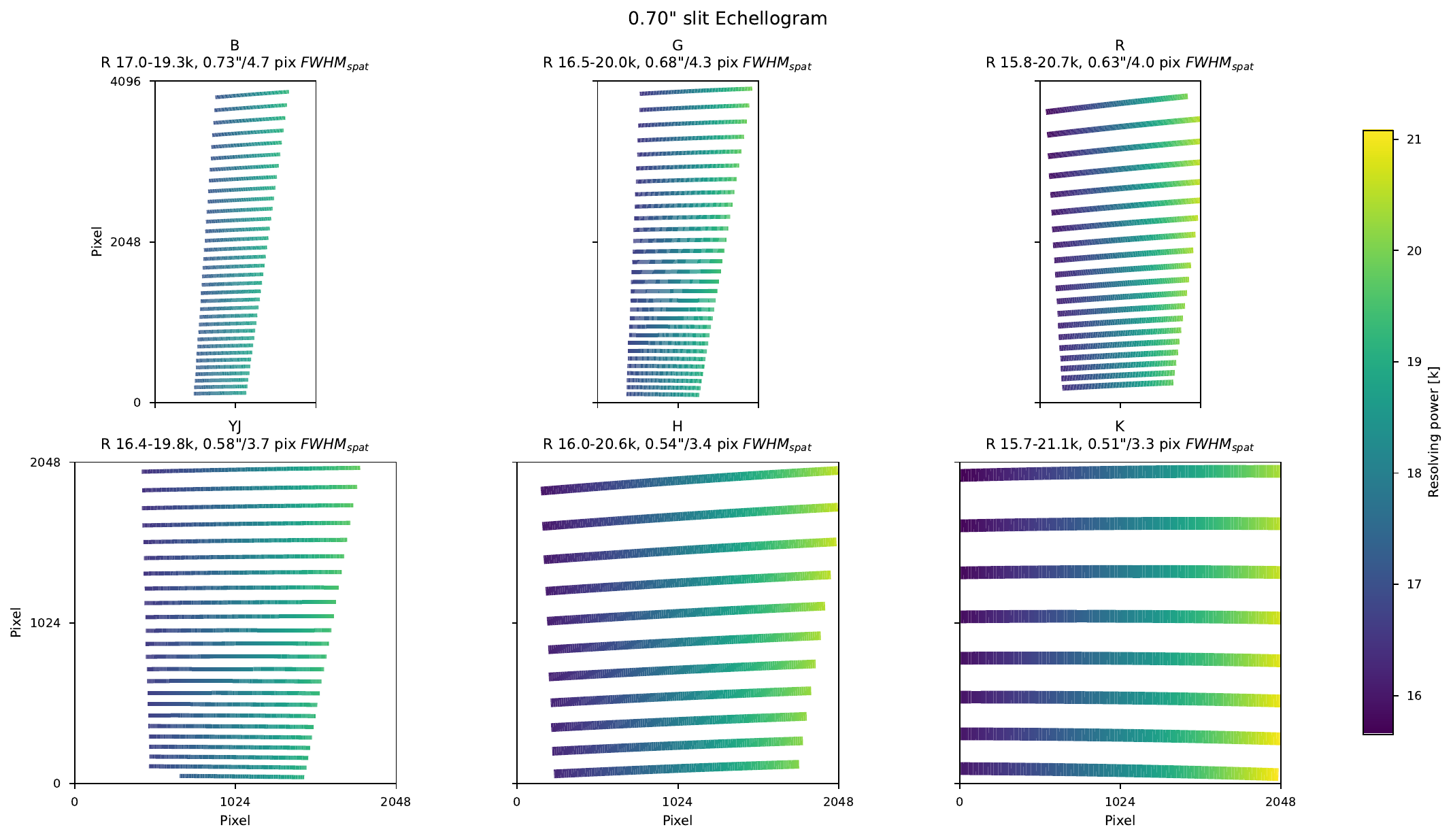
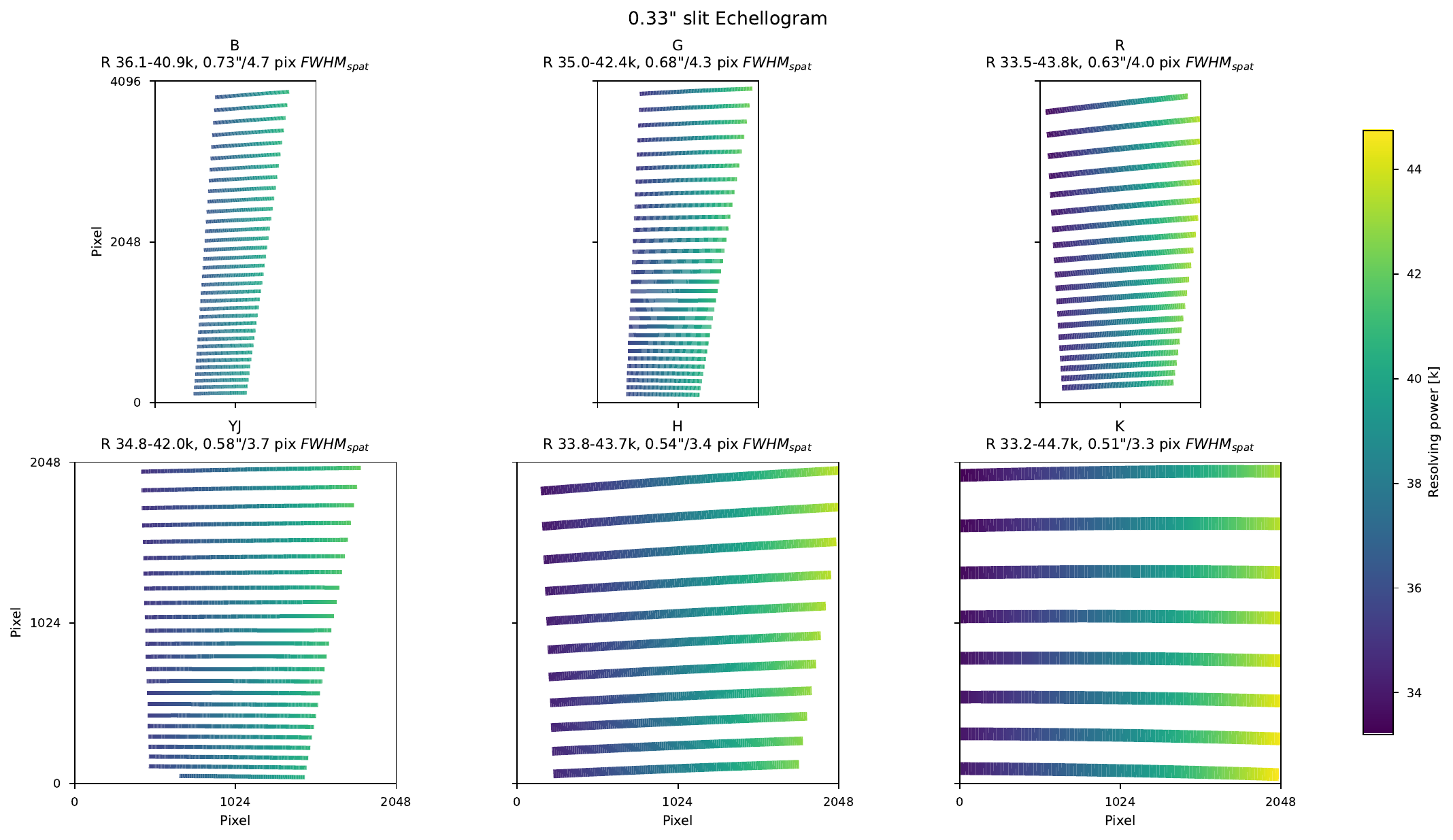
The 0.70″ slit gives R=15,700–21,100 across the six channels; the 0.33″ slit gives R=33,200–44,700. Anamorphic magnification changes resolution along each order. The plots show the actual detector formats: 2k×4k in B/G/R and 2k×2k in YJ/H/K.
Detector break-even time#
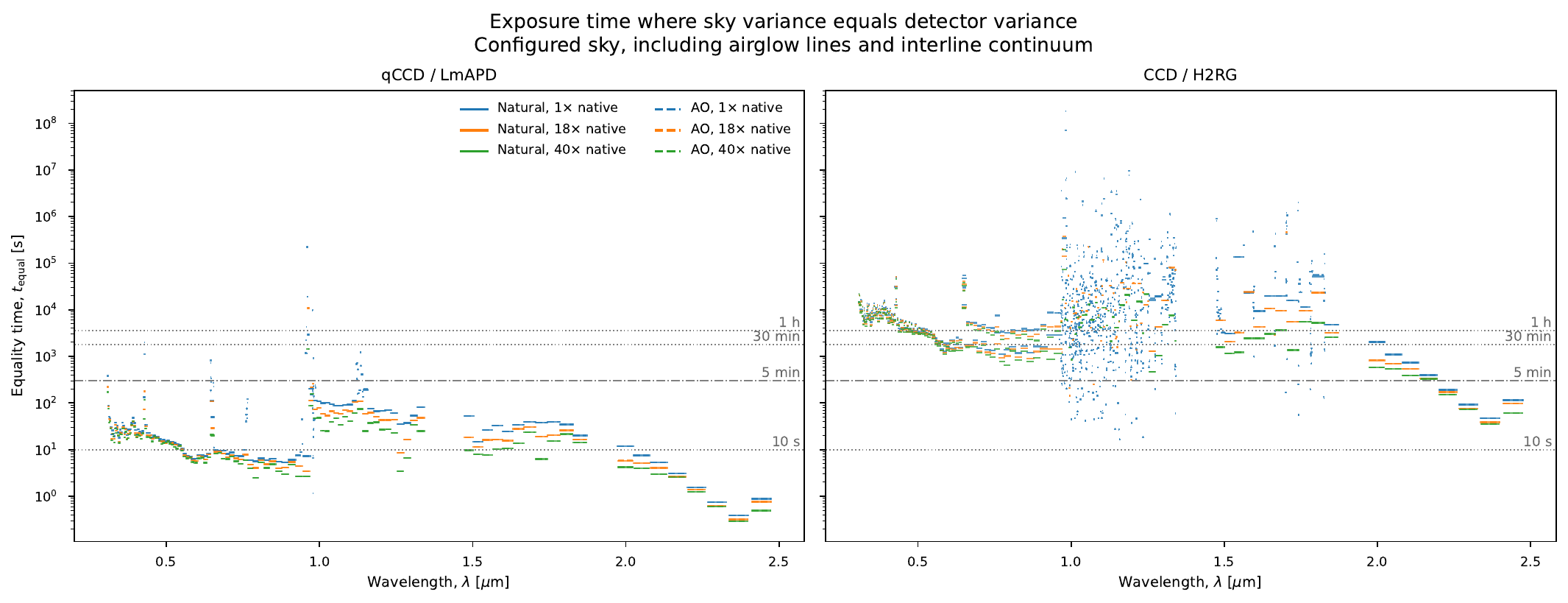
For the 0.33″ slit, representative native-resolution samples in natural seeing reach sky/detector variance equality in 29 s at 370 nm with qCCD and 17 s at 1.65 µm with LmAPD. The conventional-detector comparison gives 2.3 h and 52 min, respectively. Both include the configured OH sky; the conventional CCD calculation includes on-chip binning.
Sky levels#

The model adds astronomical continuum, interline continuum, atmospheric thermal emission, and airglow lines. At R≈1,000, S/N-based selection retains about 83% of native wavelength samples in YJ and 73% in H for natural seeing, rising to 90% and 84% with AO.
The instrument simulator contains the saved calculations and diagnostic plots.
Sources and calculation notes
Dark-time performance notebook, merged in simulator commit
6a616ea. Saved run:d383ad2-dirty, IRDBd1415c4, ScopeSim0.11.5a3. Figures are the saved PDFs converted to PNG; no simulations were rerun for this page.The ZImager estimate comes from the saved dark-time
06_ZImager.ipynbworking copy: 26.97 AB in the middle band, using aperture photometry with background-dominated noise and a local sky annulus. This notebook is not yet in the website’s simulator submodule.The one-hour table uses the notebook’s OH included, S/N optimized summary: mean magnitude in each order’s best 25% of complete bins, then median across orders. VIS/YJH are arithmetic means of the channel summaries. The notebook prose still says 20%; the executed cell and saved output use 25%.
Estimated entries apply the difference between the saved one-hour OH-disabled and OH-optimized limits to the corresponding OH-disabled case. The missing natural-seeing 0.33″ native-resolution row uses the AO 0.33″ correction: 0.01 mag in VIS and 0.02 mag in YJH. Replace these estimates when matched calculations are available.
The AO forecast still uses
ao_table.dat, with an effective red/NIR FWHM near 0.31″. Update it with the telescope-defocus and relative VIS-focus prescription before claiming sensitivity for the sharper STRATA PSFs.The science-review slides and SPIE 2026 paper/talk supply the presentation structure. Their older grey-time limits and detector-loss summaries are superseded here by the saved dark-time run.