
Kilonovae#
Kilonova spectra evolve from blue optical emission at early times to predominantly infrared emission after approximately one week.
Time sequences of optical and NIR spectra constrain ejecta velocity, temperature, and the relative blue and red components. These measurements connect neutron-star mergers to the production of heavy (r-process) elements.
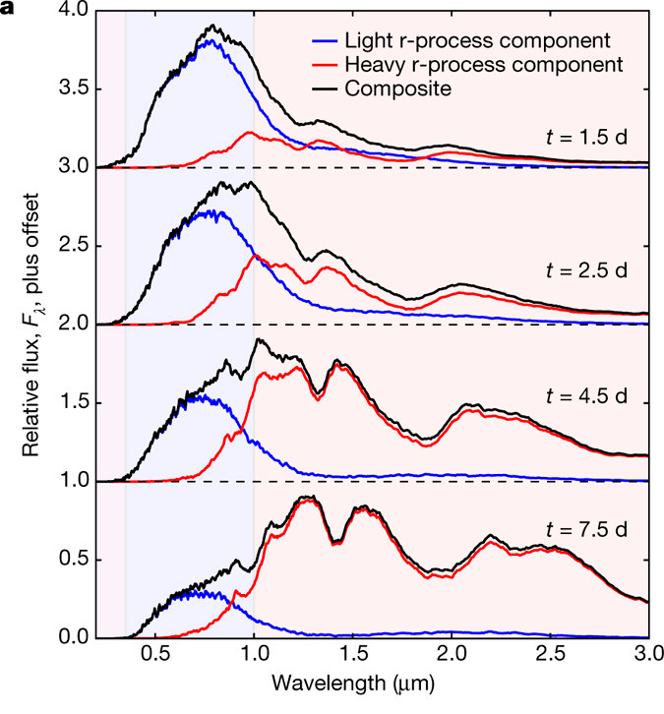
Synthetic kilonova spectra at 1.5, 2.5, 4.5, and 7.5 days. The composite spectrum shifts from the
optical to the NIR as the heavy r-process component becomes dominant.
Source: Kasen et al. 2017, Nature, 551, 80, Figure 1a; ZShooter SRD Section 2.3.1.#
Instrument Requirements#
Simultaneous 0.31 to 2.45 um spectroscopy follows the spectral energy distribution without combining observations from different epochs.
Native higher-resolution spectra can be binned to R ≈ 1,000 after pixels affected by bright sky lines are rejected.
Observing Requirements#
The required one-hour, S/N = 5 depths at R ≈ 1,000 are 24 AB in the optical, J = 23, H = 22.5, and K = 21.2.
Target-of-opportunity science exposures are required within five minutes from beam delivery. Three-band imaging remains useful after the source is too faint for spectroscopy.