
Primordial D/H#
Primordial D/H is measured from H I and D I Lyman-series absorption in metal-poor systems along z = 2 to 3 QSO sightlines.
The primordial deuterium abundance is a direct measurement of the baryon density from the early Universe. Independent QSO sightlines test whether the result depends on the gas model or on a particular absorber.
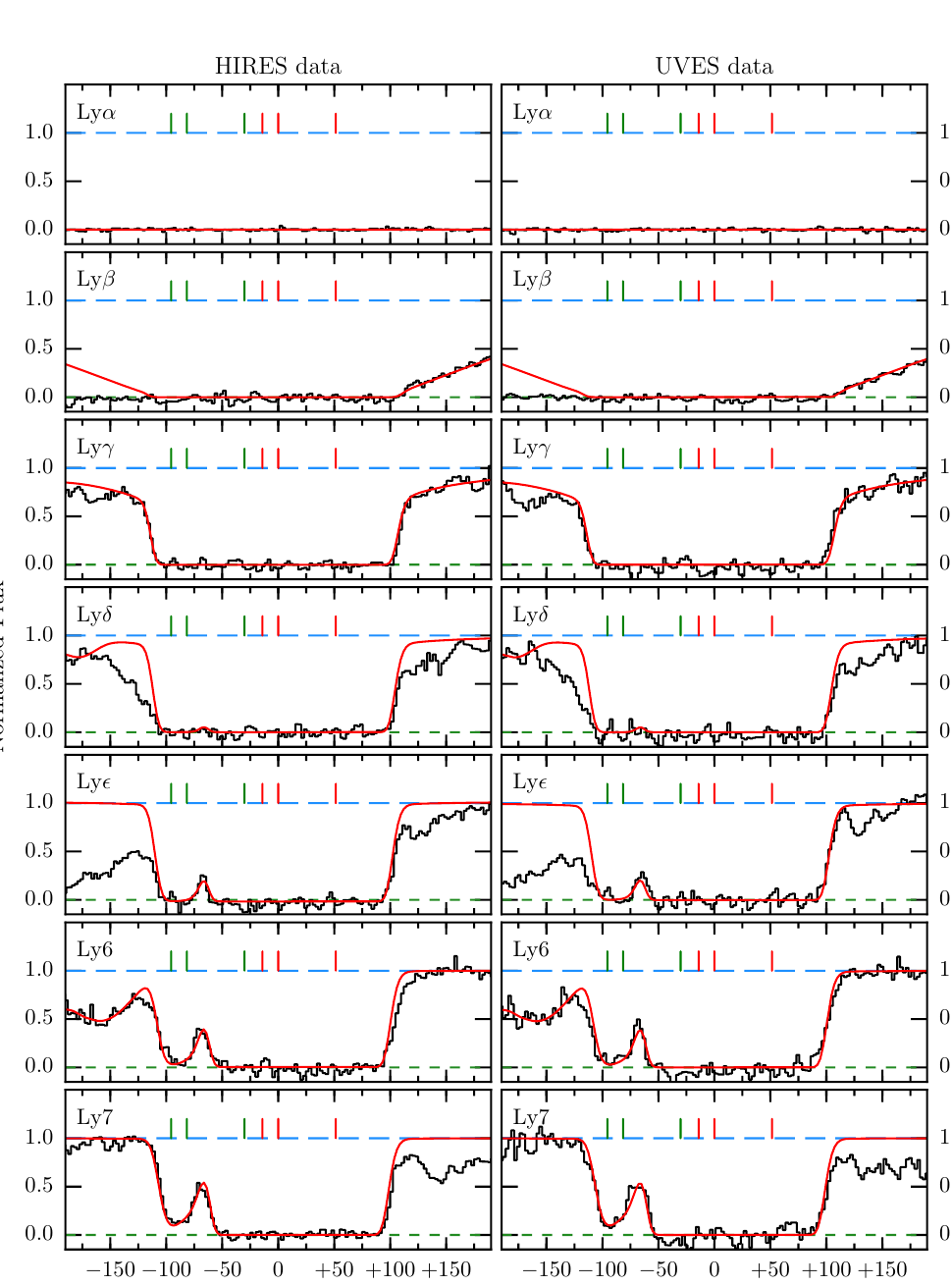
H I and D I Lyman-series absorption toward J1358+0349 observed with Keck/HIRES and VLT/UVES. Red
curves show the fitted absorption model; tick marks identify H I and D I components.
Source: Cooke et al. 2016, ApJ, 830, 148, Figure 3; ZShooter SRD Section 2.3.11.#
Science Drivers#
D I is offset from H I by ≈ 81 km/s and produces absorption at the few-percent level.
Instrument Requirements#
The useful transitions fall between 310 and 400 nm.
Observing Requirements#
The observing case uses R ≈ 40,000 and S/N at least 50 to separate D I from the H I profile and nearby absorption.
Suitable background QSOs are typically u ≈ 18 to 20 and require long integrations.