
Binaries#
Gaia astrometric binaries require long-term radial-velocity monitoring, while ultracompact binaries require phase-resolved spectroscopy and photometry.
These measurements test whether unseen Gaia companions are black holes, neutron stars, or white dwarfs, and separate them from ordinary stellar binaries. Phase-resolved data for ultracompact systems constrain masses, radii, and inclinations for binaries expected in the LISA population.
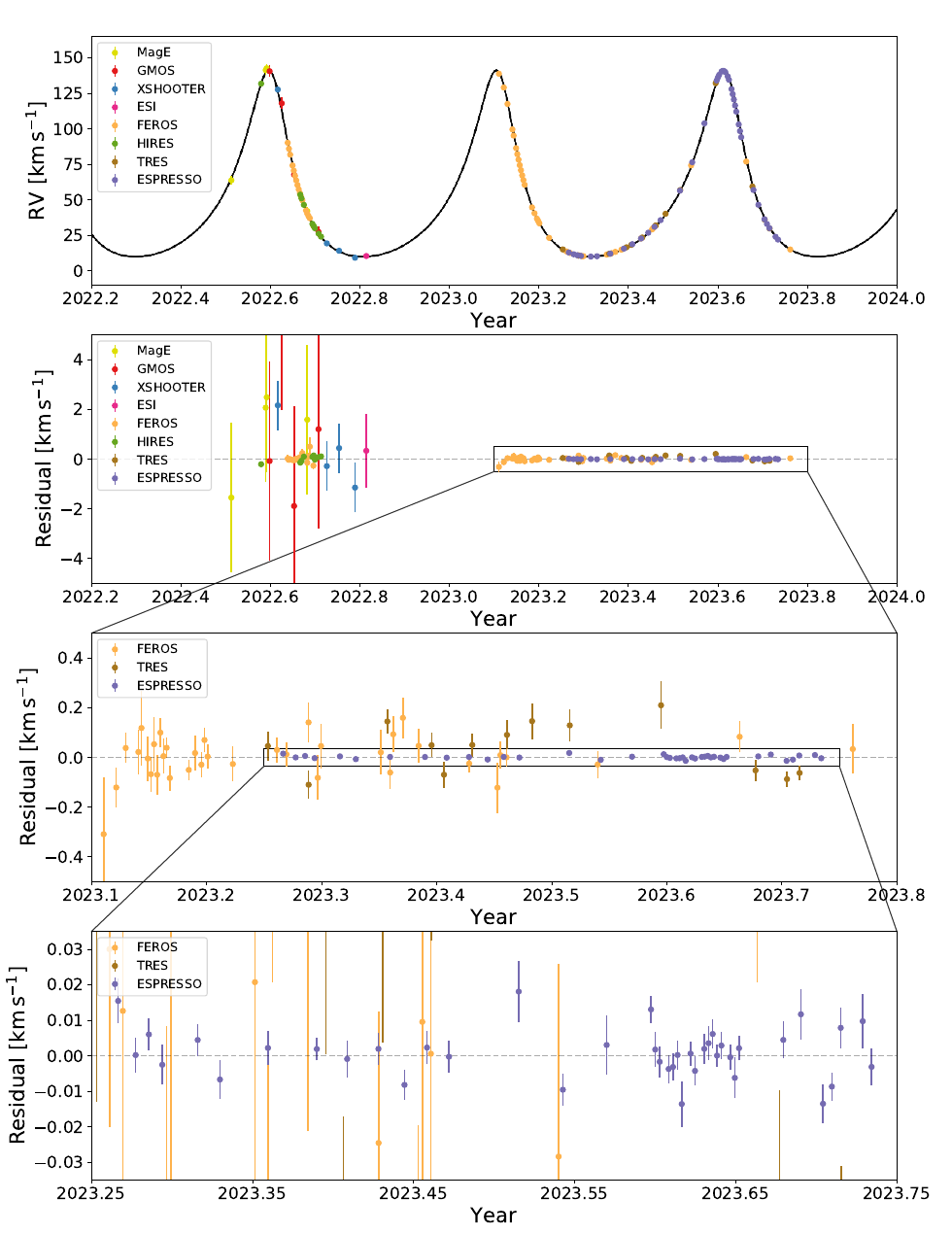
Radial-velocity orbit and residuals for Gaia BH1. Spectroscopy over three orbital cycles constrains
the Keplerian orbit and the dark companion mass.
Source: Nagarajan et al. 2024, PASP, 136, 014202, Figure 8; ZShooter SRD Section 2.3.3.#
Science Drivers#
Gaia compact-object binaries generally have periods of 1 to 10 years and RV amplitudes of order 30 km/s. The SRD estimates of order 100 discoveries.
Ultracompact white-dwarf binaries have periods of 5 to 20 minutes. ZImager light curves and ZSpec radial velocities constrain complementary system parameters.
Instrument Requirements#
For a slowly rotating FGK star, R ≈ 20,000 gives ≈ 1 km/s precision at G = 20 and S/N ≈ 5 in one hour in the SRD estimate. The current L1 stability requirement limits instrument-contributed RV error to the greater of 200 m/s or 1/60 of a native resolution element, using calibration data acquired within four hours.
Eu, Ba, La, Zr, Ce, Be, C, and O have important transitions between 350 and 450 nm. Many are blended below R ≈ 20,000. The optical R ≈ 40,000 mode provides additional line separation.