
Gravitational Lensing#
Strong lensing provides magnified spectra of high-redshift galaxies, quasars, and transients that would otherwise be inaccessible to detailed single-object spectroscopy.
These spectra measure redshifts, stellar populations, and kinematics for sources that are too faint without lensing. Separating lensed images and lens-galaxy light reduces biases in those measurements.
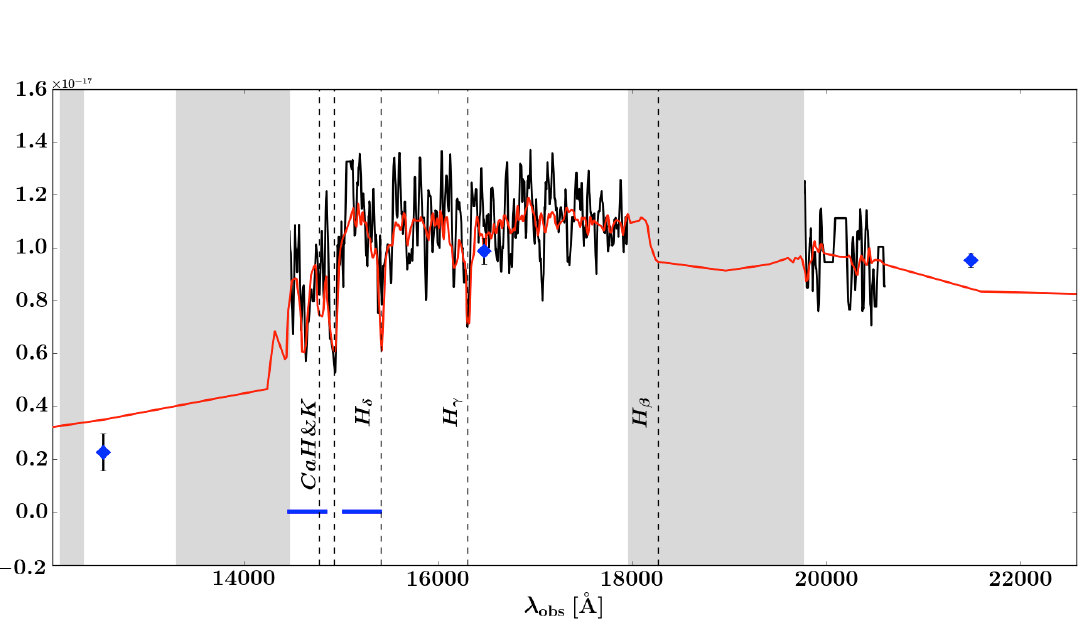
H-band X-shooter spectrum of a strongly lensed quiescent galaxy at z = 2.756. Balmer and Ca H and K
absorption provide the redshift, stellar population, and velocity dispersion.
Source: Hill et al. 2016, ApJ, 819, 74, Figure 5; ZShooter SRD Section 2.3.8.#
Instrument Requirements#
Simultaneous 0.31 to 2.45 um coverage includes rest-frame UV absorption and redshifted optical emission or absorption lines.
AO-enhanced image quality improves separation of multiple images, lens light, and compact source structure.
Observing Requirements#
Low-resolution observations target sources near i ≈ 24 at S/N = 5 for redshifts and broad spectral diagnostics.
R ≈ 10,000 to 20,000 observations target sources near r ≈ 21 for line profiles and ≈ 1 km/s radial velocities.