
Tidal Disruption Events#
Tidal disruption events are nuclear transients with blue continua and broad, evolving H and He emission. Host-galaxy light is often a substantial part of the observed spectrum.
Spectra over the rise and decline separate transient emission from host-galaxy light and track changes in H and He lines. This constrains the stellar debris and the gas around the central black hole.
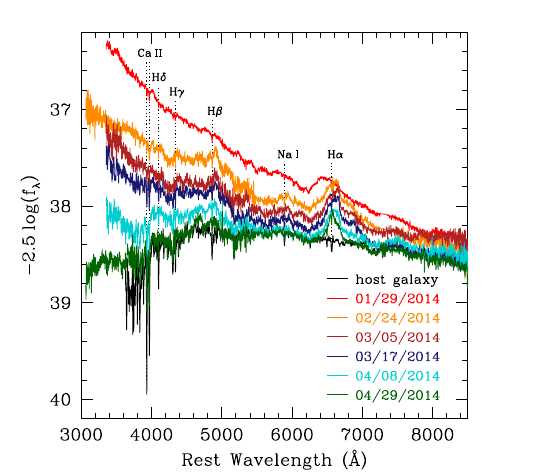
Optical spectral sequence of the tidal disruption event ASASSN-14ae. Broad H alpha remains visible
as the continuum fades.
Source: Holoien et al. 2014, MNRAS, 445, 3263, Figure 4; ZShooter SRD Section 2.3.6.#
Instrument Requirements#
Simultaneous optical and NIR spectra measure continuum shape, line evolution, extinction, and possible dust echoes.
AO-enhanced image quality at ≈ 0.3 arcsec improves separation of the nuclear transient from the host.
Observing Requirements#
The optical reference depths are u ≈ 22.5 and g ≈ 23 at S/N ≈ 10 and R ≈ 1,000 in 30 minutes.
The NIR reference depths are J ≈ 23 and K ≈ 21.5 at S/N ≈ 5 and R ≈ 1,000 in one hour.
The nominal response time is within one day. Three-band imaging supports host subtraction and light-curve measurements.