
Relativistic Explosions#
GRB afterglows and luminous fast blue optical transients require rapid low-resolution spectroscopy while the source remains observable.
Early spectra determine redshift and classification while the continuum is still bright. They also measure absorption and line changes before the source fades.
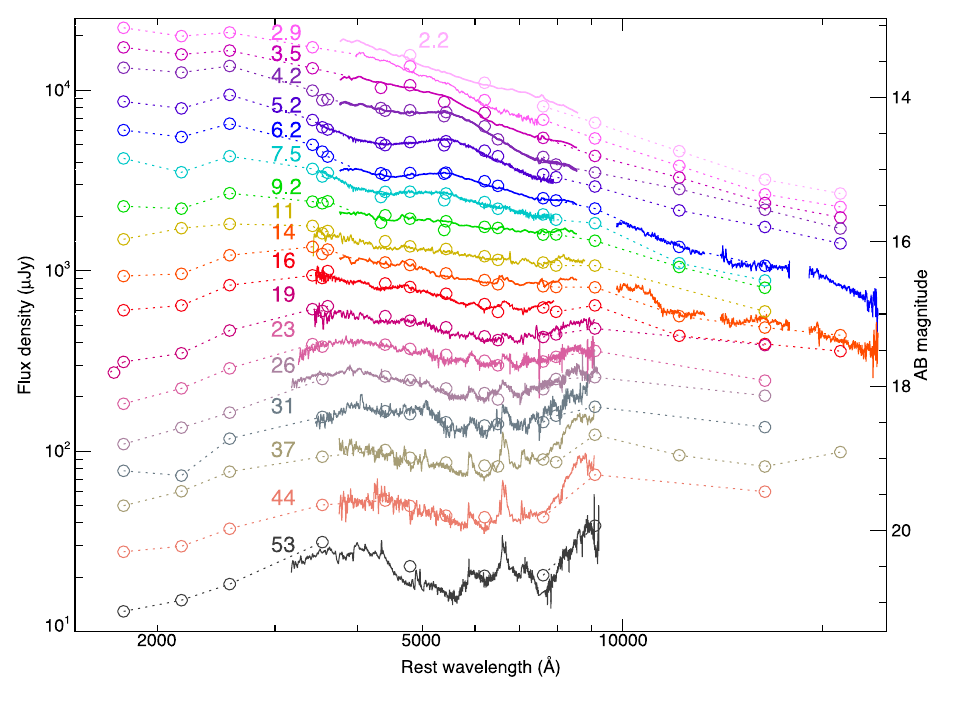
UV-to-NIR spectral energy distribution sequence of AT2018cow. Spectra and photometry show rapid
evolution from a hot, nearly featureless continuum to line-rich optical and NIR emission.
Source: Perley et al. 2019, MNRAS, 484, 1031, Figure 4; ZShooter SRD Section 2.3.4.#
Instrument Requirements#
Simultaneous 0.31 to 2.45 um coverage provides redshifts, continuum shape, and absorption diagnostics, including high-redshift GRB afterglows.
Three-band imaging provides detections, colors, or limits when spectroscopy of the transient is no longer feasible.
Observing Requirements#
Reference targets are u ≈ 24.5 for GRB afterglows and r ≈ 24 for luminous fast blue optical transients, at S/N = 5 after binning to R ≈ 1,000.
The required response is within five minutes, with individual exposures no longer than ≈ 10 minutes.